
A few months ago, I wrote about a case that forced me to reconsider how I think about internet addiction.
Since then, I’ve reviewed three additional cases with striking similarities.
High-functioning adults.
Intelligent.
Employed.
Avoidant of exposure.
Shame-sensitive.
And spending hours immersed in digital activity they describe as compulsive.
But here’s the key observation:
They are not chasing pleasure.
They are preventing structural collapse.
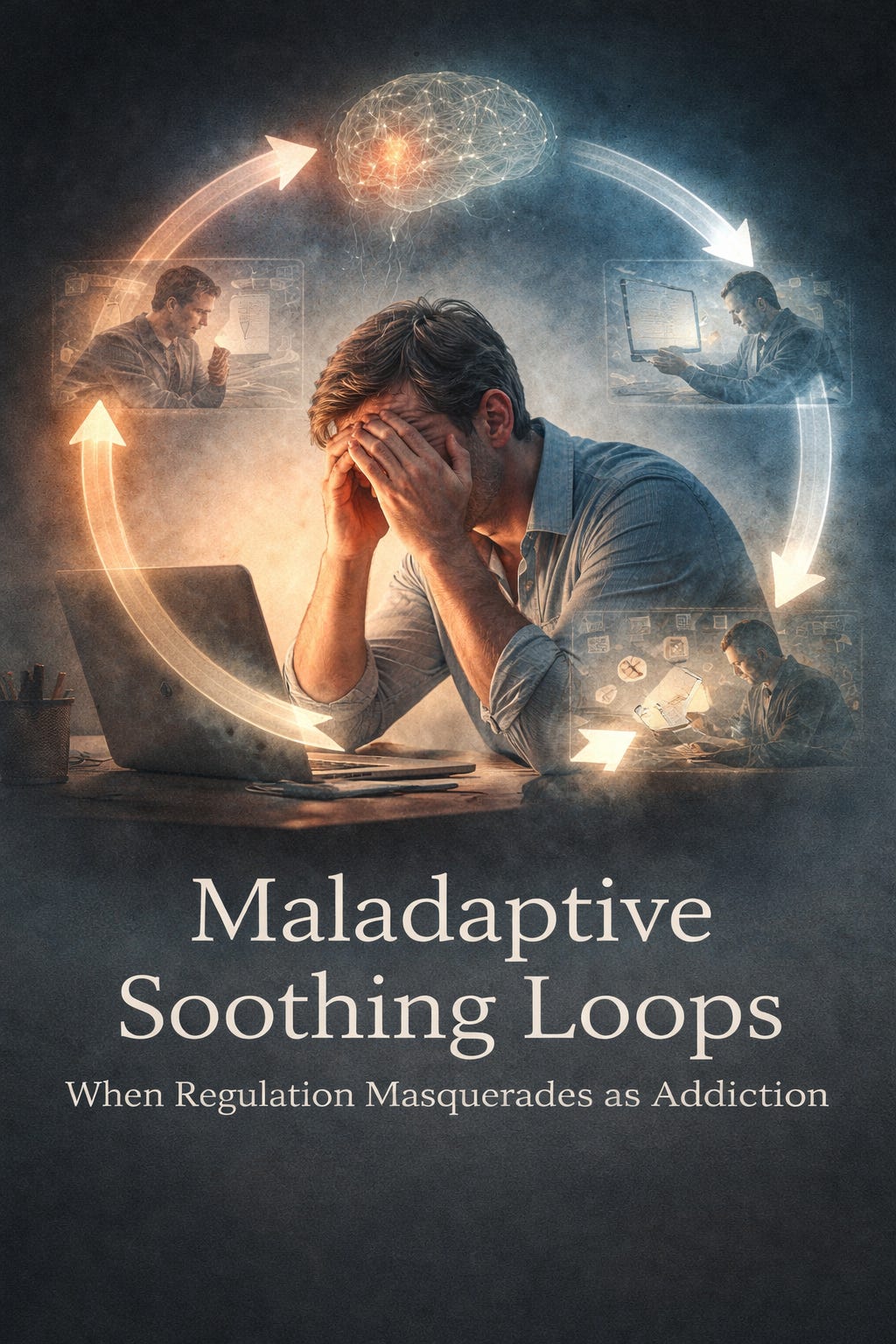
The Loop
What I began noticing was not an addiction pattern.
It was a regulatory loop.
It looks like this:
1. Trigger
Performance pressure. Anticipated evaluation. Conflict exposure. Decision demand.
2. Affective Activation
Shame. Anxiety. Fear of inadequacy. Cognitive fog.
3. Protective Behavior
Scrolling. Sorting. Organizing. Rehearsing imagined conversations.
4. Immediate Effect
Reduced autonomic arousal. Less shame. Less exposure.
5. Long-Term Cost
Stalled growth. Avoided risk. Reinforced avoidance identity.
The behavior is not the primary disorder.
It is a soothing mechanism that has become overgeneralized.
Why It’s Not Pure Addiction
Traditional behavioral addiction models emphasize:
Dopaminergic reinforcement
Craving
Reward-seeking
Tolerance escalation
In these cases, the dominant experience is different:
Relief, not euphoria
Avoidance, not stimulation
Fog, not excitement
Collapse prevention, not thrill pursuit
When behavioral restriction was imposed first, dissociation increased.
That is not typical of reward-driven addiction.
It is typical of regulatory destabilization.
The Shame Variable
What unifies these cases is shame under evaluation.
These individuals often have:
Histories of high intelligence with stress-induced shutdown
Exam paralysis or “fogging” under pressure
Avoidance of visible performance opportunities
Intense internalized inadequacy narratives
The internet becomes a controllable environment where evaluation disappears.
No one is watching.
No one is judging.
No one is scoring.
Why Naming the Loop Matters
When we reframe the behavior as a Maladaptive Soothing Loop, three things shift:
Shame decreases.
Curiosity increases.
Regulation improves.
The question changes from:
“Why can’t you control yourself?”
to:
“What are you protecting yourself from feeling?”
That question opens treatment.
This Is a Working Model
I am referring to this regulatory pattern as a Maladaptive Soothing Loop.
It is not a diagnosis.
It is not a new disorder.
It is a clinical lens.
In several cases, shifting from behavioral suppression to affect tolerance has led to measurable improvements in exposure, task initiation, and dissociation reduction.
This model is currently being explored further through structured clinical observation.
If you are a clinician encountering similar presentations, I invite you to consider whether regulation—not reward—may be the primary driver.
Because sometimes the loop isn’t addiction.
It’s anesthesia.